Artificial intelligence has transformed the way people write. Tools like ChatGPT, Claude, and Gemini can generate essays, articles, reports, and emails that closely resemble human-written content.
As language models become more sophisticated, identifying AI-generated writing has become an increasingly complex technical challenge.
Modern AI detectors use natural language processing (NLP), machine learning, and statistical analysis to identify patterns associated with machine-generated text.
However, detecting AI writing involves much more than looking for repetitive phrases or unusually polished sentences.
Understanding how these systems work helps explain both their capabilities and limitations.
1. How Does AI Text Detection Actually Work?
AI text detection is generally treated as a classification problem.
A machine learning model analyzes a piece of writing and estimates whether its characteristics resemble human-written or AI-generated content.
Unlike plagiarism detection, which searches for similarities between documents, AI detection examines linguistic patterns.
These patterns can include:
- Sentence structure and variation.
- Vocabulary diversity.
- Repeated words and phrases.
- Statistical predictability.
- Relationships between words and sentences.
- Consistency of writing style.
For example, a document containing highly repetitive sentence structures may exhibit characteristics associated with certain AI-generated texts.
However, these characteristics are not exclusive to artificial intelligence.
Academic papers, technical documentation, and professional reports frequently use predictable language.
Therefore, a single writing pattern cannot reliably establish authorship.
Modern detectors typically combine multiple signals to produce a classification.
2. Text Preprocessing: Preparing Content for Analysis
Before an AI detector can analyze writing, the text must be prepared for processing.
This stage is known as text preprocessing.
Using Python libraries such as NLTK or spaCy, developers can divide documents into sentences, identify words, and organize text into a format suitable for machine learning.
Common preprocessing operations include:
- Removing unnecessary whitespace.
- Identifying sentence boundaries.
- Tokenizing text into words or subwords.
- Handling special characters.
- Preparing text for machine learning models.
However, excessive preprocessing can remove valuable information.
Punctuation, capitalization, and sentence boundaries may reveal important stylistic patterns.
For this reason, effective detection systems must balance text normalization with preserving meaningful linguistic features.
The resulting text can then be analyzed using statistical methods or neural network models.
3. Feature Extraction: Finding Patterns in Writing
Feature extraction is a central component of traditional machine learning approaches to AI detection.
It involves transforming written language into measurable characteristics.
Sentence Length and Variation
AI-generated text may exhibit relatively consistent sentence structures.
Developers can calculate average sentence length and measure variations across a document.
However, consistent sentence length is not sufficient evidence of AI involvement.
Vocabulary Diversity
Vocabulary diversity measures how many different words appear in a text.
One simple metric is the type-token ratio, which compares unique words with the total number of words.
Although this can reveal repetition, the result is sensitive to document length and topic.
N-Gram Frequency
N-grams are sequences of neighboring words.
By analyzing frequently repeated combinations, detection systems can identify recurring linguistic patterns.
For example, repeated transitions or sentence openings may contribute to a detector's classification.
These features can help train traditional classifiers, including logistic regression, support vector machines, and random forests.
However, newer detection systems increasingly rely on neural language models that learn more complex contextual relationships.
4. How Transformer Models Improve AI Detection
Transformer-based architectures have significantly expanded the capabilities of natural language processing.
Models such as BERT analyze relationships between words while considering their surrounding context.
Rather than relying exclusively on manually selected features, transformer classifiers learn patterns from large collections of labeled text.
During training, the model processes examples of human-written and AI-generated content.
It gradually learns representations that help distinguish between these categories.
This approach can capture complex linguistic characteristics that traditional statistical methods may overlook.
However, transformer-based detection introduces additional challenges.
Training data must represent different writing styles, topics, languages, and AI models.
A detector trained primarily on older language-model outputs may struggle with writing produced by newer systems.
This makes ongoing evaluation and model updates important.
5. Why Sentence-Level AI Detection Matters
Many early AI detectors focused on classifying an entire document.
However, modern writing often combines human-authored passages with AI-generated or AI-edited sections.
A single document-level score may hide these differences.
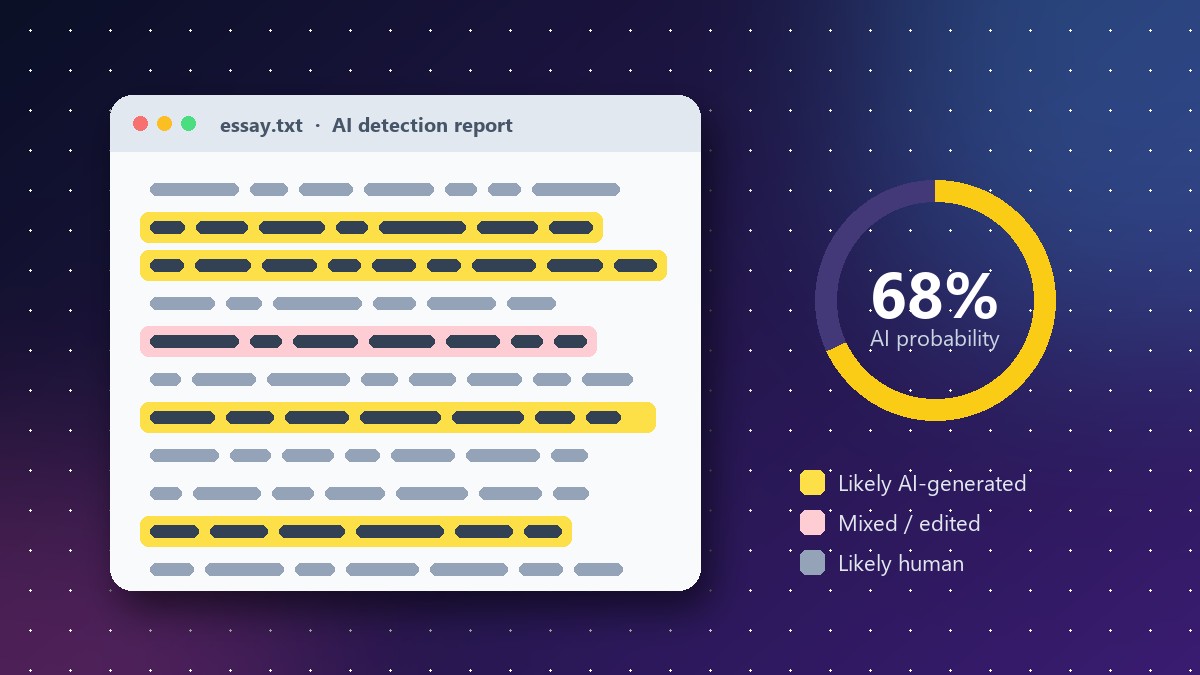
Sentence-level analysis attempts to identify which parts of a document contribute to the overall detection result.
For example, a student might write an introduction independently, use AI assistance for several body paragraphs, and then revise the conclusion manually.
A document-wide classification may not adequately represent this mixture.
Sentence-level detection can provide more useful information by highlighting passages that deserve closer review.
Nevertheless, individual sentence classifications may be less reliable because short passages contain limited statistical evidence.
Context remains essential when interpreting results.
6. Solvely AI Detector: Combining Multiple Detection Perspectives
Solvely AI Detector demonstrates how modern AI detection platforms can combine advanced text analysis with practical writing-review features.
One of its main advantages is its multi-engine detection approach.
Rather than presenting only one assessment, Solvely offers checking options associated with ZeroGPT, GPTZero, and Turnitin-style detection.
These options allow users to compare different detection signals.
Multi-Engine AI Detection
Different AI detection systems may use different training datasets, algorithms, and classification thresholds.
Consequently, the same document can receive different results from different detectors.
Solvely's multi-engine approach helps users identify disagreements between assessments.
Agreement between multiple systems can provide useful supporting context, although it does not guarantee correctness.
Sentence-Level Analysis
Solvely provides sentence-level highlighting to help users identify passages associated with AI-generated writing patterns.
This makes its reports more actionable than a simple document-wide percentage.
For example, a content editor can review highlighted sentences and examine whether they contain repetitive wording, generic explanations, or unusually uniform structures.
BERT-Based Research
Solvely's published technical research describes a detection approach involving dual BERT encoders, sentence-level analysis, and document-aware calibration.
Its research presents these components as a way to examine mixed human and AI writing while accounting for broader document context.
These architectural descriptions explain the intended approach, although independently verified benchmark results are still necessary to establish comparative accuracy.
From AI Detection to Writing Improvement
Identifying potentially AI-generated passages is only one part of a useful writing workflow.
Once a passage has been flagged, writers may want to improve its clarity, sentence variety, or overall readability.
Solvely AI Humanizer provides a complementary rewriting tool designed to help transform awkward or overly mechanical language into more natural text.
Writers can review suggested changes, preserve the intended meaning, and make further edits to reflect their individual voice.
However, rewriting text does not establish human authorship or guarantee a particular detection result. Academic users should also follow their institution's rules concerning AI assistance.
A Broader AI-Powered Study Experience
For students, AI detection is often part of a larger learning and writing process.
Solvely also operates as an ai study tool, offering resources for homework assistance, mathematical problem solving, flashcards, quizzes, and exam preparation.
This broader collection allows students to move between learning activities and writing review without relying on completely separate platforms.
The combination is particularly relevant to learners who use AI responsibly to understand difficult concepts, organize study materials, and improve the clarity of their work.
7. Why AI Detection Is Still Imperfect
Despite advances in machine learning, AI-generated text detection remains an open technical challenge.
Several factors affect reliability.
False Positives: Human-written content may be incorrectly classified as AI-generated, particularly when it follows formal or predictable writing patterns.
False Negatives: AI-generated passages may be classified as human-written, especially after substantial editing.
Short Text: Brief passages provide fewer linguistic signals for classification.
Model Evolution: New language models continuously introduce writing patterns that may differ from existing training data.
Paraphrasing: Rewriting can alter the statistical characteristics used by detection systems.
Research has shown that paraphrasing can weaken certain detection methods, while watermark-based approaches face their own robustness challenges.
Another important distinction is that an AI probability score does not necessarily represent the percentage of words written by artificial intelligence.
Depending on the detector, it may indicate a model's confidence or another system-specific estimate.
For these reasons, AI detection should support investigation rather than serve as definitive proof of authorship.
8. The Future of AI Text Detection
Future AI detection systems will likely place greater emphasis on combining multiple technical approaches.
Potential developments include:
- More sophisticated transformer-based classifiers.
- Better analysis of mixed human and AI writing.
- Improved sentence-level contextual interpretation.
- More robust evaluation across languages and writing styles.
- Watermarking and content provenance technologies.
- Clearer explanations of detection confidence and uncertainty.
Watermarking is particularly interesting because it attempts to introduce identifiable statistical signals during text generation.
However, watermark detection generally depends on compatible generation systems and cannot identify every possible AI-generated document.
Consequently, no single method is likely to solve every detection challenge.
Conclusion
AI text detection has evolved from simple statistical analysis into a sophisticated field involving natural language processing, transformer models, and contextual classification.
Traditional techniques such as vocabulary analysis and n-gram frequency remain useful, but modern systems increasingly combine them with neural network architectures and more detailed reporting.
Solvely illustrates how multi-engine checking, sentence-level analysis, and complementary writing tools can make AI detection more practical for everyday users.
However, even advanced systems cannot establish authorship with absolute certainty.
The future of AI detection lies in combining stronger technical methods with transparent reporting, responsible interpretation, and human judgment.
Got a coding query or need some guidance before you comment? Check out this Python Code Assistant for expert advice and handy tips. It's like having a coding tutor right in your fingertips!